By Emily Di Natale
It took me two months to get through Kazan’s silverscreen film, ‘On the Waterfront’. Not because it was boring. Baby’s nap time, for a stay-at-home mum, is precious, and anything dedicated to that time testifies to its own merit. I would catch scenes at 5:30am in the morning (after resettling my eight month old for another hour of sleep) and finally finished it one day just before he woke up from his afternoon nap.
I had my doubts about the film, having a vague idea that it was a bit messy, had something to do with socialism and was mainly about tough blokes and fighting. But once I started, I knew I had to get to the end, nap-time by nap-time.
I guess I shouldn’t have been surprised. ‘On the Waterfront’, directed by Elia Kazan, received 12 Academy Award nominations, winning eight, including Best Picture, Best Actor (Marlon Brando), Best Supporting Actress, (Eva Marie Saint) and Best Director. It is set on the waterfronts of New Jersey among the dock workers, locals and the corrupt union, and was partly inspired by a series of Pulitzer Prize-winning newspaper articles by Malcolm Johnson entitled, ‘Crime on the Waterfront’ (1948).
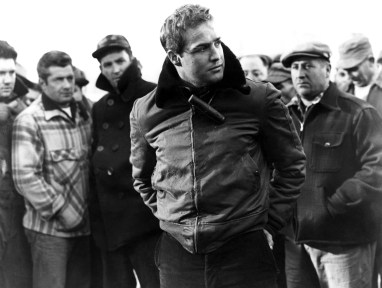
The cinematography is stunning, with touches of film noir that invigorate the drama, suspense and moral questions within the story. Kazan’s opening shot is dominated by a large black and white ship. Low rumbling percussion that evokes dark jungle music introduces the action, and gradually develops a contemporary jazz rhythm as a group of characters emerge from a building on the dock. The stark chiaroscuro of the ship gives way to more subdued greys as the figure of Terry Malloy (Marlon Brando) takes the screen. I can’t help but find the play of blacks, whites and varying hues of grey telling. They suggest the morally uncertain landscape (or cityscape) in which the characters grope their way around, many of them scrambling over one another for survival. Is the labyrinth of morality an inscrutable grey zone? Or is the truth black and white?
Such questions force themselves on the unwilling Terry Malloy. In the film’s opening we find him satisfied to benefit from the support of corrupt union official Johnny Friendly and play ‘d and d’ (deaf and dumb) to the illegal activities championed by said official. But when Malloy becomes an unwitting instrument in Friendly’s murder of a man about to testify against the union in court, his simple back and white existence of survival is thrown into a grey turmoil.
And to complicate matters he becomes smitten with the sister of the murdered man, Edie Doyle (Eva Marie Saint), who is intent on breaking the waterfront silence and finding out who killed her brother. Edie enters the action like a beacon of light, first seen bending over her dead brother, her blonde hair glowing white against a murky background. When Father Barry tells Edie he’ll be in the church if she needs him, Edie challenges the priest: ‘Whoever heard of a saint hiding in a church?’
Father Barry rises to the challenge and we find him a few scenes later, preaching by the body of a dead man:
‘Some people think the crucifixion took place only on Calvary. They better wise up … every time the mob puts the crusher on a good man, tries to stop him from doing his duty as a citizen, it’s a crucifixion. And anyone who sits around and lets it happen… shares the guilt of it.’
The scene is powerful, and Father Barry has been described by critics as ‘a tower of strength’ (A.H. Weiler, 1954). The priest continues to speak out as Friendly’s men pelt him with rubbish in an attempt to silence him. Terry Malloy looks on, compelled to consider his own part in the scheme of corruption on the waterfront. Marlon Brando, through pensive facial expressions and subtle movements, does a superb job of capturing the interior struggle of his character in this moment. Previously Terry had commanded Edie to, ‘Quit worrying about the truth all the time. Worry about yourself.’ These words underscore the essence of the waterfront attitude. An attitude that is undergoing a metamorphosis within Terry, almost against his own will. One perceives that he cannot help but be struck by the poignant words of the priest who speaks out to a poker-faced, hostile crowd.
Terry is an unlikely hero; rough, poorly educated, happy to let corruption occur around him but undesirous to get too involved. In many ways he represents the average citizen, secure in the status quo. As I watch him flounder in this sleazy whirlpool of dishonesty and vice I am reminded of my own world, a world full of dangers, politics, scandal, self-service. It’s a world that I have brought a child into, a place that I often fear. And my baby snoozes in the next room, oblivious to his mother’s gloomy musings.
In the final scenes I watch Terry finally stand up to Johnny Friendly. He is almost beaten to death in the process as his fellow dock workers look on numbly, wavering between helping him and not wanting to get involved. (And, caught him in this moment of suspended disbelief, I feel like yelling at the screen, ‘There are hundreds of you and only a handful of Friendly’s mob, you cowards!’) But even the conventional sheep-like crowd, traditionally known for maintaining the existing state of affairs, wake up and stand by Terry in the end. My faith in humanity is restored.
I watch the close ups of Terry’s blood-darkened face against a white sky, as he walks with his fellow dock workers away from the vanquished Friendly. His drab world of colourless amorality, foggy motives and murky deeds has been pierced with the chiaroscuro of truth. For once, the grey zone gives way to black and white.
As I type the last paragraph I hear the chattering of my now 10 month old as he rummages around in his cot, bright eyed and bushy tailed for the day. I quickly squeeze a few more words out of the keyboard, reflecting that it is a dangerous world in which to bring up kids, but it is a good world and it is full of good people. Perhaps scared people, even cowardly. People who don’t want to rock the boat. But when push comes to shove many will do it. I hope that I can imbue my own kids with a sense of what it right, the courage to see in the greyness. So that they make good choices, without fear.
———————————————————–
Other Links:
 The "Recordatio" Cinema Club