By Pablo Vila
Rome Open City felt as though it was divided into a series of acts, and in the first set we are lulled into the sense that the occupation of Rome by the Nazis is a difficult albeit palatable existence, where the occupied people face hardship and humiliation by the oppressors on a daily basis, but behind the safety of closed doors they can continue to be their Italian selves as they always were: passionate, gregarious and closely supportive of each other’s situation. We see children playing and getting up to mischief, a wedding being planned, a slightly bumbling priest who is on the periphery but doing his best to ensure all in his care are at ease. Play by the rules, keep to the curfew, look out for yourself and survive from day to day.
In later acts, the film starts to gradually reveal to us the growing menace that is the Nazi occupation. We start to see more glimpses of the subversion occurring with the endearing Communist resistance fighters trying to undermine the Nazis, the children venting their impotent anger by causing an explosion and we see more harassment of the Romans and their constant fear of what will happen next. A turning point occurs when we see a residential building evacuated at gun point and the sudden wanton murder of Pina, loving mother, faithful fiancee and bride to be that very day. The scene begins as another routine but humiliating check by the soldiers but ends disastrously with the death of Pina, representing every woman, mother and wife oppressed. Another child is orphaned and her fiancee miserably captured seeing the murder first hand. We are faced with the reality that the Nazis see the Italians as merely animals to be controlled and tolerated, where there is little room for negotiation or understanding.
As the film progresses so does the role of Don Pietro, who is seen to be intelligent, subversive and quietly courageous throughout. He is there in all the important moments, offering spiritual advice, helping the children, aiding the resistance via non-violent means and trying always to help and save those in danger using his respected and trusted status in society. He does not waver, staying true to his faith and being the shining light in the darkness of the occupation. As the film comes to its intense climax, the capture and torture of the resistance leaders, it is Don Pietro who stands firm in courage, but never violent, judgemental or hopeless.
A poignant insight into the powerful brainwashing of the Nazi propaganda machine comes in the final scenes with the chief interrogator of the SS berating a fellow soldier for his alcoholic moment of clarity. The drunkard blasts the inhumanity, evil and pointlessness of their Nazi “mission”. What is highlighted here is the danger of ideology and its false allure. The SS commander’s cold and manipulative female counterpart uses her poisonous deceit to expose the Resistance leaders and smilingly rewards the traitor with a fur coat. Through all this we see how humanity can be pushed to the extreme with the Resistance leaders brutally tortured, all the while the SS commander attempts to break the will of Don Pietro.
In the extraordinary final scenes, we see Don Pietro overcome with such grief and anger at seeing this torture that even the Nazis momentarily fear his presence. His mind soon turns towards forgiveness for the perpetrators, displaying his true strength of character and moral fortitude. His execution does not end as a triumph for the Nazis. Rather, we see the children whistling a resistance tune in support of their beloved priest and the Italian soldiers purposely misfiring, and in these acts there is the inevitability that this was a good man who had done no wrong. A Christ-like figure with no perjury in his mouth, refusing to insult or berate his tormentors at his death, could only be hastily killed by the very Nazi soldier who earlier had exposed his true pathetic sentiments about the war.
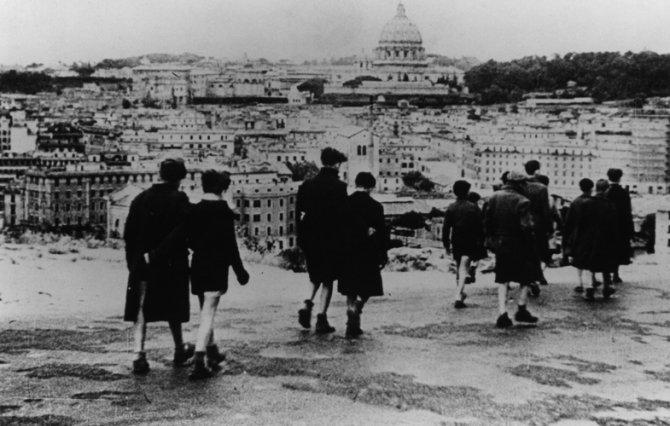
The final image of St. Peter’s reminds us of a longer Roman history and the tumult once experienced in the days of the Early Church and the first martyrs. However, the movie could have been set anywhere and in any time of history. The Nazis stand for any unjust regime, and what is revealed in this film is the permanence of one man’s unshakeable Christian faith, his love for those around him (even his Nazi torturers) and the hope he inspires in the people. We are reminded that Christianity is not just lived deep within us but is made alive in the love we show for others, especially in times of adversity when it is hardest and demands the most of us. As Don Pietro died, I imagine he could easily have been thinking of Jesus’ words “be not afraid” and “I am with you always to the end”, a hopeful message that our world needs frequent reminding of today.
 The "Recordatio" Cinema Club